
The Limits of Board Games: History, Sensitivity, and Creative Responsibility
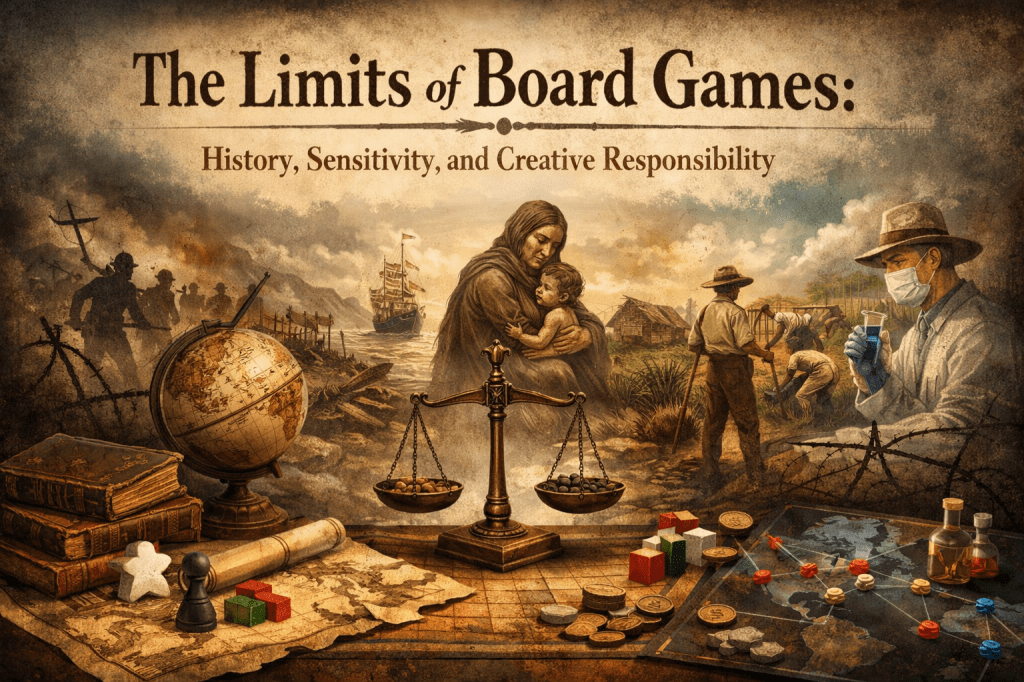
In my recent conversation with journalist Pavel Barter of The Sunday Times Ireland, we explored our games, our approach to historically sensitive subjects, and the ethical and creative boundaries that shape modern board-game design.
During the conversation, several questions were raised about how delicate themes should be handled, the importance of historical context, and the educational role a game can and perhaps should play. A central point of the discussion was the controversy surrounding The Great Hunger, a game developed by a third party, and the wider debate it has sparked about representing one of the most traumatic periods in Irish history through a playable experience.
The case of The Great Hunger has prompted a legitimate and necessary discussion about the extent to which human tragedy can be transformed into a game, particularly when that experience is framed in competitive terms or risks simplifying real suffering. Critics have argued that the game’s structure, presentation, and promotional material lack sufficient historical depth and sensitivity, and that defining “success” or “victory” in the context of mass starvation and forced emigration can feel deeply uncomfortable and, for many, unacceptable. Regardless of the creators’ intentions, it became clear that the absence of deep, carefully framed historical context can provoke strong and justified reactions.
As an Irish company, this issue carries particular weight for us. Our position is clear: whenever we engage with historical themes especially those that form part of our collective heritage we carry an increased responsibility to approach them with rigour, respect, and thorough research. This is not simply about avoiding controversy, but about honouring history and the people who lived through it.
This philosophy has guided our work to date and will continue to shape our future projects. A concrete example is Equestrian, currently in development, which is rooted in the Irish heritage of horse racing and show jumping. From the outset, the project has been supported by extensive historical and cultural research, dialogue with experts, and a constant concern for representing this tradition not merely as entertainment, but as an integral part of Irish identity.
During the conversation, we also referred to widely accepted games on the market to illustrate how difficult themes can be treated with varying degrees of sensitivity. Puerto Rico, for example, is a game in which it is historically evident that the “colonists” represent enslaved labour, yet this reality is never explicitly addressed within the game’s narrative. Even so, it remains broadly accepted because its design avoids glorification or sensationalist exploitation of the subject.
Another example is Pandemic Iberia, which addresses diseases such as malaria, typhus, and cholera epidemics responsible for the deaths of millions. The game approaches these subjects with an educational and historical focus, prioritising scientific understanding and context over shock value or graphic representation.
These examples reinforce a fundamental idea: how a game is designed matters as much as the subject it explores. A board game can engage with extremely sensitive topics provided it does so with clear intent, respect, historical accuracy, and creative responsibility.
We cannot and should not alter history to make it more comfortable. The past is often harsh, violent, and unjust. The real challenge lies in finding the balance between historical fidelity and contemporary sensitivity. Choosing to make a game educational rather than gratuitous or offensive is a conscious decision of both design and ethics.
Ultimately, the question remains: what are the limits of board games? There may be no single answer. But those limits undoubtedly lie in the responsibility of creators, the depth of their research, and the intention behind how themes are presented. Playing can and should also be a way of learning, questioning, and better understanding history, even when that history is uncomfortable.
by Hugo Silva, 2026
 Seven Castles Games