
The Playtesting Journey
🎲 A Milestone – Based Path to a Publishable Board Game
Designing a board game is a thrilling mix of creativity, logic, and resilience. Yet, no matter how brilliant the idea or elegant the mechanics, no game succeeds without one critical process: playtesting. At Seven Castles Games, we follow a milestone-based system to guide our designs from first draft to final publication-ready prototype.
Here’s an inside look at our structured playtesting progression refined over the development experience with targeted goals at every stage.
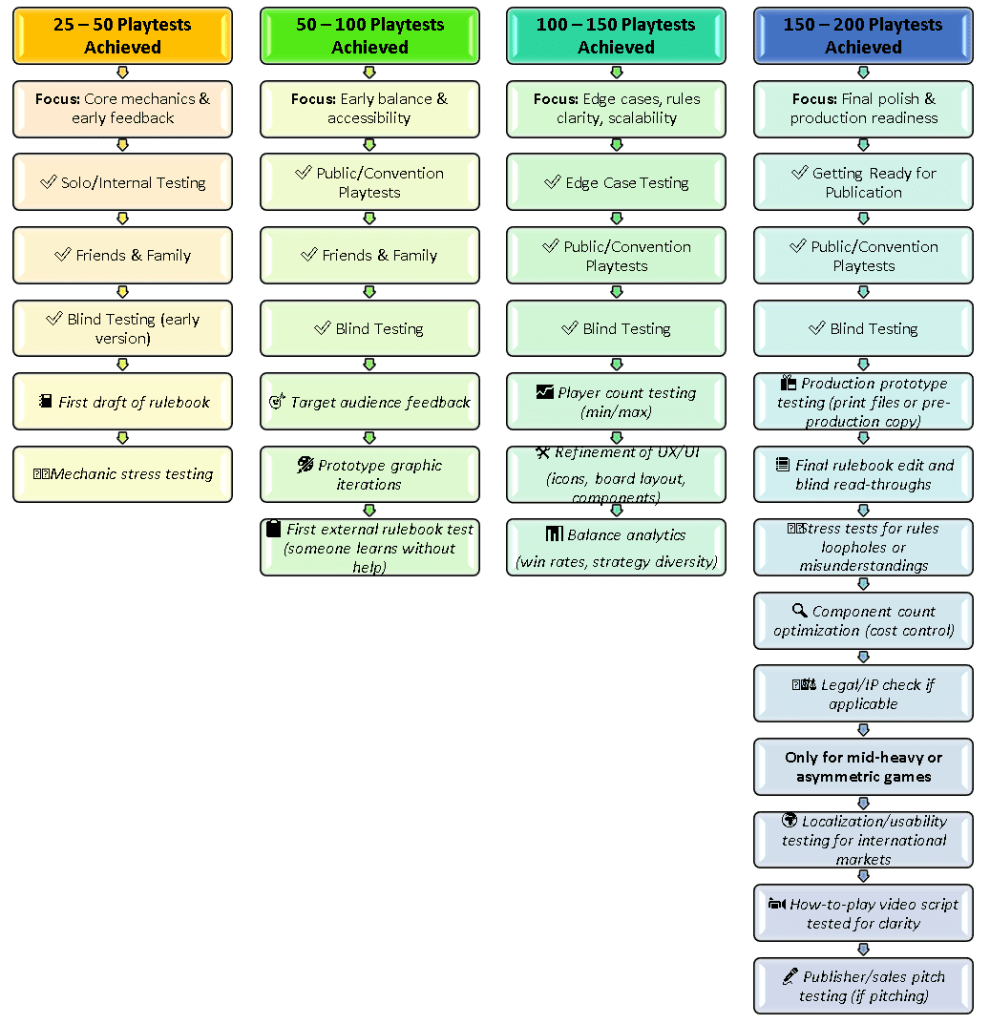
🔰 Milestone 1: 25–50 Playtests Achieved
Focus: Validating Core Mechanics
In the early stages, we aim to stress test the game’s foundational systems. These initial 25–50 playtests are typically internal and casual, but they are vital.
Activities:
- Solo/Internal Testing — Does the game work mechanically? Are turns fluid?
- Friends & Family — Great for spotting friction points or unclear rules.
- Early Blind Testing — Testing if the game is understandable without guidance.
- First Rulebook Draft — Start documenting how the game should be played.
- Mechanic Stress Testing — Try extreme or unusual strategies.
📌 Goal: Confirm that your idea is not only playable but worth refining.
🧪 Milestone 2: 50–100 Playtests Achieved
Focus: Balance & Accessibility
Once the game functions well, we scale testing to wider audiences to gather more objective and strategic feedback.
Activities:
- Public/Convention Playtests — Exposure to real-world audiences and fresh eyes.
- Friends & Family Feedback Loop Continues
- Mid-Stage Blind Testing — Testers read the rulebook independently.
- Audience Feedback — Are we reaching our target demographic?
- Component Design Iterations — Update the prototype’s layout and iconography.
📌 Goal: Discover balance issues, edge confusion, and fun factor from varied players.
🧠 Milestone 3: 100–150 Playtests Achieved
Focus: Edge Cases & Rule Clarity
Now that the game has legs, it’s time to refine the balance, plug edge case loopholes, and finalize UX design.
Activities:
- Edge Case Testing — Target specific strategies and rare occurrences.
- Advanced Public Testing — Including larger conventions and experienced gamers.
- In-Depth Blind Testing — Rulebook and prototype tested without support.
- Balance Analytics — Monitor win rates, decision diversity, and fairness.
- Player Count Testing — Ensure the game works well from minimum to maximum player count.
- Component & Layout Refinement — Finalize icons, layout clarity, and board space logic.
📌 Goal: The game should now feel tight, polished, and resilient.
🚀 Milestone 4: 150–200 Playtests Achieved
Focus: Publication Readiness
At this stage, the game is transitioning from prototype to product. Testing becomes final validation rather than discovery.
Activities:
- Final Blind Testing — Players must be able to play with zero assistance.
- Pre-Production Testing — Use near-final components or print-ready files.
- Final Rulebook Proofing — Edits for clarity, grammar, layout.
- Component Optimization — Reduce unnecessary parts or costs.
- Publisher/Partner Feedback — If applicable, share with prospective publishers or backers.
- IP & Legal Review — Ensure originality and protection where necessary.
📌 Goal: Lock in the game’s final version for production or Kickstarter launch.
🏁 Optional Milestone: 200+ Playtests
For Legacy, Asymmetric, or Heavy Games
Games with complex systems or evolving narratives benefit from continued iteration.
Add-ons:
- Localization Testing — Ensure clarity across languages and cultures.
- Media Testing — Run scripts for “how-to-play” videos or tutorials.
- Retail & Pitch Testing — Refine how the game is introduced to stores or investors.
📌 Goal: Reinforce the game’s scalability and long-term viability.
🎯 Final Thoughts
Playtesting isn’t just about fixing what’s broken, it’s about discovering what makes your game truly shine. A structured milestone-based approach keeps development on track, balances feedback, and ensures that no critical element is left behind.
At Seven Castles Games, this approach helps us stay focused and deliver games that are not only fun, but truly ready for the shelves.

by Hugo Silva, 2025
 Seven Castles Games