
Turning Data into Design
Our Excel Approach to Game Balance
Designing a board game is a mix of creativity, intuition… and a lot of spreadsheets. While the stories, art, and mechanics give life to a game, balance is what makes it enjoyable and fair. Nothing kills a good playtest faster than a card or ability that feels completely overpowered. That’s why at Seven Castles we developed a method to bring structure into our balancing process: we use Excel as our secret weapon.
Gameplay Balance Defined
Gameplay balance is the fine-tuning of mechanics to assure a fair and enjoyable experience. It means tweaking progression, resource management, and risk-reward systems so that all abilities of all players, skilled or not, remain engaged.
A balanced game takes into account several key factors:
- Challenge vs. Reward: players should feel satisfied when they overcome a challenge. Engagement drops if the challenge is too punishing or the reward too small.
- Skill vs. Accessibility: whether a player is new or experienced, mechanics should allow both to participate meaningfully.
- Game Economy: from resource distribution to cooldowns, no single strategy should dominate.
- Pacing & Flow: the balance of action and downtime must keep players engaged without overwhelming them.
Our Excel Method
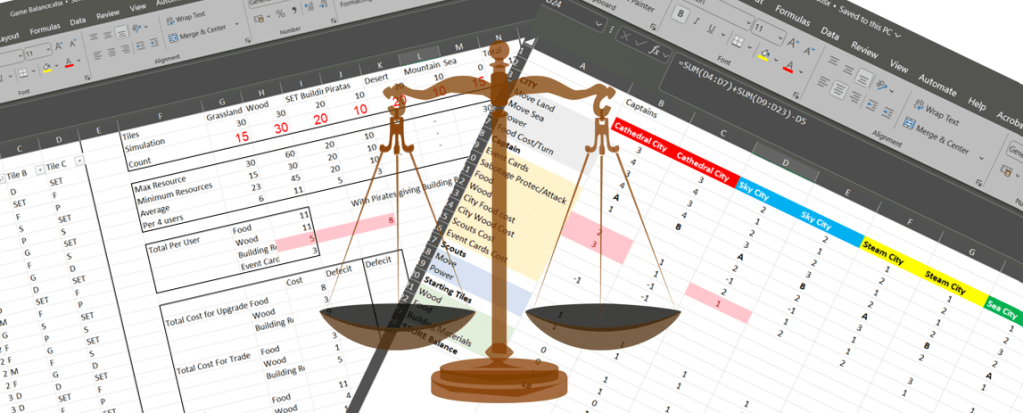
In the case of our game Steam Cities, we created a detailed spreadsheet where every card, tile, minister and event is given a weight and a score. This allows us to measure their relative power and compare them side by side.
- Captains & Ministers: each city has leaders with unique abilities. By scoring their power, movement, and influence, we can average results and ensure no city starts with an advantage.
- Tiles: resource generation is modelled in Excel to check totals and distributions, keeping every path viable but not dominant.
- Event Cards: each event is measured by impact and VP. This prevents a single card from ending the game prematurely.
With this framework, any card or ability that looks suspiciously strong is flagged in the spreadsheet before it ever reaches the table.
From Numbers to Playtests
Of course, balance is not only numbers, it’s also about feeling. But having this structured approach reduces the number of fixes we need during playtesting. Instead of constantly adjusting after each game, we already know the ranges are fair, and can focus on player experience, strategy depth, and fun.
That said, of course we always miss one or two cards that only in real playtests reveal themselves as too overpowered. And that’s fine, because playtesting is where the Effective Balancing Techniques come in:
- Play-testing & Iteration: feedback highlights problem spots and helps fine-tune mechanics.
- Data-Driven Adjustments: results like win/loss ratios and VP accumulation guide our tweaks.
- Risk–Reward Systems: high-risk strategies must come with equally high rewards.
- Asymmetry & Fairness: cities and ministers aren’t identical, but their strengths and weaknesses are designed to stay fair.
For example:
- Some ministers initially had abilities every season, which made them dominant. Our sheet confirmed they were too strong, so we limited them to once per year.
- Event cards that granted too many Victory Points were reduced, preventing early endings.
- Steam City upgrades were recalibrated so all cities now offer fair, diverse victory paths.
The Results
Using Excel didn’t replace creativit, it empowered it. With less time spent patching obvious problems, our prototypes matured faster, and playtests became more about fine-tuning than firefighting.
This process not only saved us countless iterations but also made the games more fun, fair, and consistent.
And of course, none of this would be possible without our amazing playtesters. Their time, feedback, and sharp eyes helped us validate the numbers and turn spreadsheets into experiences that truly shine on the table.
by Hugo Silva, 2025
 Seven Castles Games